

Amphetamine Salts — what they are, how they differ, and how to tell them apart
Overview
The free base form of amphetamine produced by synthesis is typically converted into a salt for oral, intranasal or intravenous use. While the free base can be inhaled or formulated as an oral suspension or an orally disintegrating tablet (ODT), most available material is marketed and used as Amphetamine Salts. Below we explain what those salts are, how their physical properties differ, and how much active amphetamine each contains by weight.
Common salt forms and physical properties
Three principal salt forms are encountered:
- Amphetamine sulfate
- Amphetamine phosphate
- Amphetamine hydrochloride (HCl)
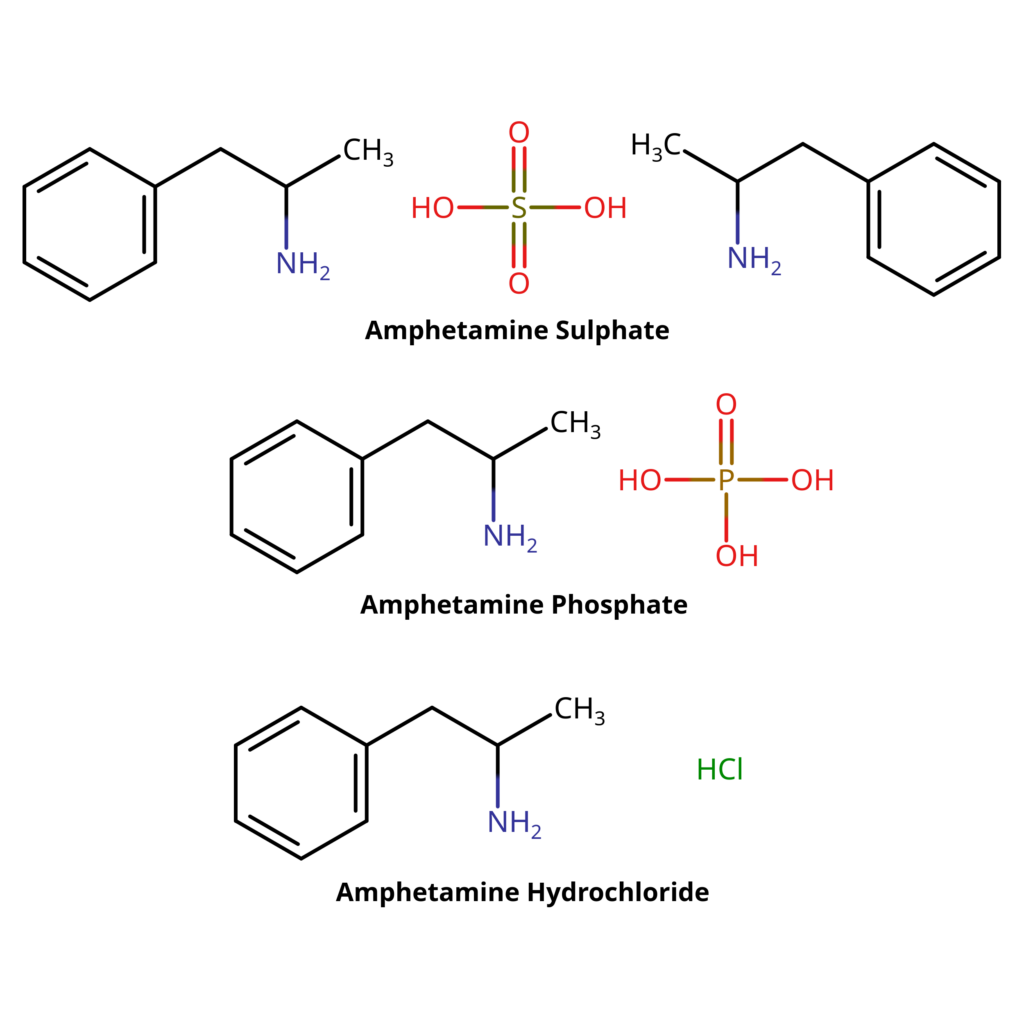
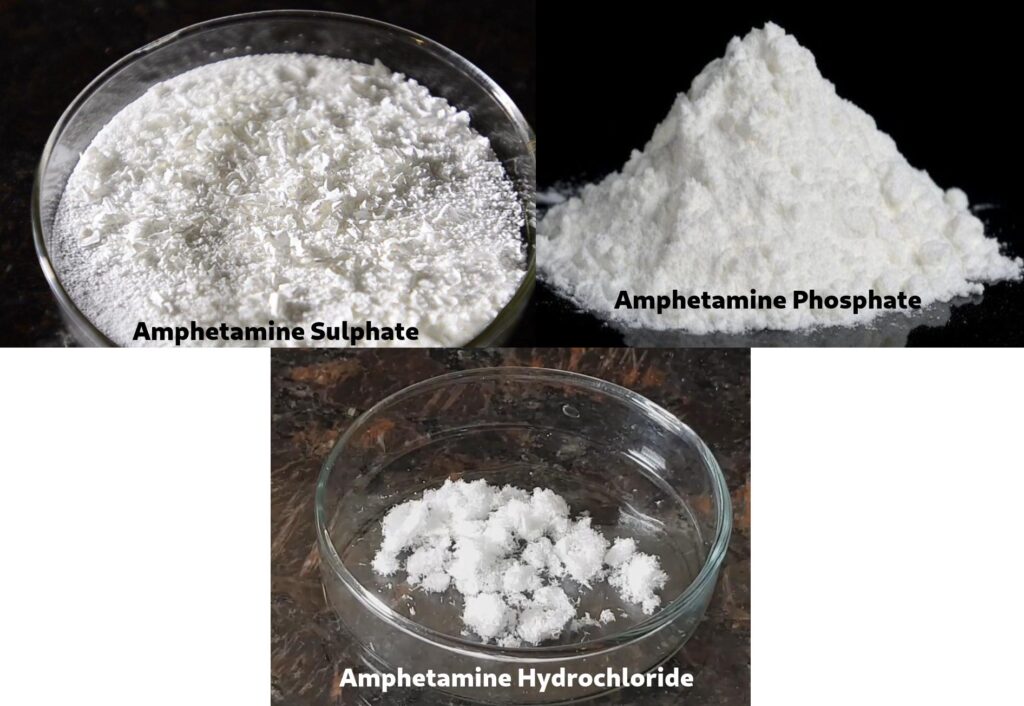
All three, when pure, appear as white powders; any coloration typically indicates impurities. In practice, amphetamine sulfate and amphetamine phosphate form comparatively dense, crystalline powders with higher bulk density, whereas amphetamine hydrochloride tends to be amorphous and fluffy with lower bulk density. Hydrochloride is notably more hygroscopic (it absorbs moisture from air) and is therefore best stored tightly sealed. Sulfate and phosphate salts are generally more stable under normal storage.
From a pharmacological standpoint, the active cation is the amphetamine molecule; the acid counter-ion (sulfate, phosphate, chloride) simply balances charge. The relative amount of free amphetamine per gram of salt determines how much active substance is present in a given weight of salt.
Amphetamine Salts. How much amphetamine is in 1 g of each salt?
Using the molar masses listed below and the molar mass of the amphetamine free base (135.21 g·mol⁻¹), the amphetamine content per gram of salt works out (rounded) as follows.
Molar masses used
- Amphetamine sulfate (formula with two amphetamine cations per sulfate): 368.50 g·mol⁻¹
- Amphetamine phosphate (monovalent salt in this context): 233.20 g·mol⁻¹
- Amphetamine hydrochloride: 171.67 g·mol⁻¹
- Free base amphetamine: 135.21 g·mol⁻¹
Calculated active amphetamine per 1 g of salt (rounded):
- Amphetamine sulfate: ~0.73 g amphetamine per 1 g of salt (sulfate salts commonly have two amphetamine cations per sulfate anion, which is reflected in this value).
- Amphetamine phosphate: ~0.58 g amphetamine per 1 g of salt.
- Amphetamine hydrochloride: ~0.79 g amphetamine per 1 g of salt.
Thus, amphetamine sulfate and amphetamine hydrochloride are similar in amphetamine content per gram, while amphetamine phosphate contains noticeably less—roughly 1.3–1.4 times less active amphetamine than the hydrochloride salt.
Myths About Differing Amphetamine Salts Subjective Effects
Claims that one salt is inherently “more stimulating” or “more euphoric” than another lack a solid pharmacological basis. In vivo, the counter-ion is rapidly dissociated and amphetamine is metabolized into species that act on monoamine systems (e.g., dopamine). Perceptible differences reported by users are more likely due to impurities, formulation differences, dosing inaccuracies, or placebo effects rather than the intrinsic identity of the anion. Pure amphetamine—regardless of salt form—delivers the same active molecule to the body.
Amphetamine Salts. Pharmaceutical Products and Formulations.
Many prescription amphetamine medications are supplied as salts or combinations of salts. Examples of marketed products that include amphetamine salts or enantiomeric mixtures include Adderall (a mixture of amphetamine salts), Adderall XR, Mydayis, Adzenys ER/XR-ODT, Dyanavel XR, Evekeo (amphetamine sulfate, racemic), and dextroamphetamine products such as Dexedrine and Zenzedi. Lisdexamfetamine (Vyvanse) is a prodrug of dextroamphetamine that is structurally distinct and inactive until metabolized. Historically, free-base formulations were marketed under names such as Benzedrine; today most commercial products use salt forms because the free base is comparatively volatile. (The development of oral suspensions and ODTs containing the free base began in the 2010s.)
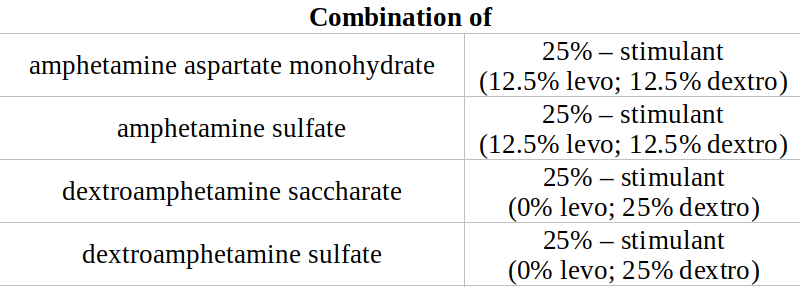
For example, the brand formulation Adderall is a blend of four different amphetamine salts (amphetamine aspartate monohydrate, amphetamine sulfate, dextroamphetamine sulfate, and dextroamphetamine saccharate) arranged to produce a roughly 3:1 ratio favoring dextroamphetamine; this increases the proportion of the dextro enantiomer in the final product and affects the clinical CNS profile.
Simple, Qualitative Tests For Ion Identity
The following reactions are qualitative, established chemical tests for the presence of sulfate, phosphate, or chloride ions. These are described here only as a transformation of the content you provided. Exercise appropriate legal and safety caution: performing chemical tests or handling controlled substances may be illegal in many jurisdictions and can be hazardous.
Basic sample preparation: dissolve about 100 mg of the sample in 7–10 mL of room-temperature water to make an aqueous solution for the following observations.
Sulfate (SO₄²⁻) — characteristic precipitates. Amphetamine Salts.
- Strontium chloride (SrCl₂): addition to a sulfate-containing solution forms a white precipitate of SrSO₄; SrSO₄ is insoluble in acids.
- Barium chloride (BaCl₂): produces a white precipitate BaSO₄, which is insoluble in strong or dilute acids.
- Silver nitrate (AgNO₃): aqueous dilute sulfate typically does not give a strong precipitate with AgNO₃ (silver sulfate is fairly soluble in water), although very concentrated solutions can yield some deposition.
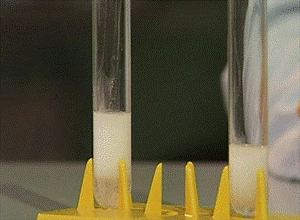
Typical sulfate precipitate colors: strontium sulfate — white; barium sulfate — white.
Phosphate (PO₄³⁻) — color changes and precipitates. Amphetamine Salts.
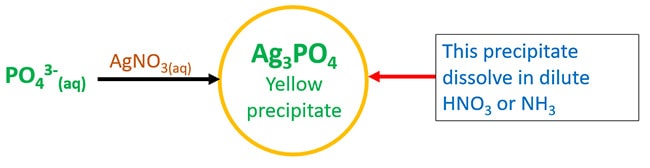
- Silver nitrate (AgNO₃): reacts with phosphate to give silver phosphate (Ag₃PO₄), a yellow precipitate; this dissolves in dilute nitric acid or ammonia.
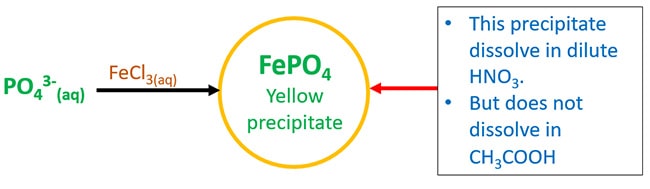
- Ferric chloride (FeCl₃): produces ferric phosphate (FePO₄), a yellow precipitate that dissolves in dilute nitric acid but not in acetic acid.
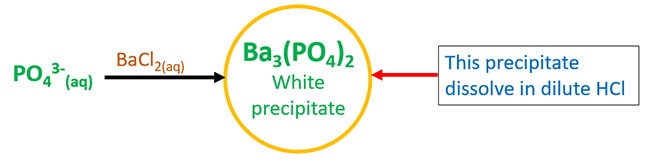
- Barium chloride (BaCl₂): can form Ba₃(PO₄)₂, a white precipitate that dissolves in dilute hydrochloric acid.
Chloride (Cl⁻) — lead salts give a white precipitate. Amphetamine Salts.
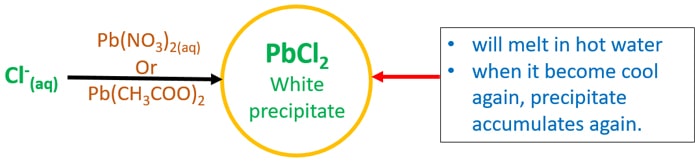
- Adding an aqueous chloride solution to lead(II) acetate or lead(II) nitrate yields lead(II) chloride (PbCl₂), a white precipitate:
- Pb(CH₃COO)₂ (aq) + 2 Cl⁻ → PbCl₂ (s) + 2 CH₃COO⁻ (aq)
- Pb(NO₃)₂ (aq) + 2 Cl⁻ → PbCl₂ (s) + 2 NO₃⁻ (aq)
Closing notes
- Amphetamine Salts are primarily different only in counter-ion, crystal form, density and hygroscopicity; the pharmacologically active moiety is the amphetamine cation.
- Reported subjective differences between salts are poorly supported by pharmacology and usually stem from impurities, formulation, or dosing differences.
- If you need an SEO-friendly rewrite focused on the keyword Amphetamine Salts, I can also produce a short meta description, H2/H3 headings optimized for search, or a condensed FAQ section targeted at search queries — tell me which format you prefer.
Sources
- Popper, Charles W. “The story of four salts.” Journal of Child and Adolescent Psychopharmacology 4.4 (1994): 217-223. https://www.liebertpub.com/doi/abs/10.1089/cap.1994.4.217?journalCode=cap
- Ahmann, Peter A., et al. “Placebo-controlled evaluation of amphetamine mixture—dextroamphetamine salts and amphetamine salts (Adderall): efficacy rate and side effects.” Pediatrics 107.1 (2001): e10-e10. https://publications.aap.org/pediatrics/article-abstract/107/1/e10/66525/Placebo-Controlled-Evaluation-of-Amphetamine