

Preparation Of Gaseous Nitrogen
Introduction to Gaseous Nitrogen
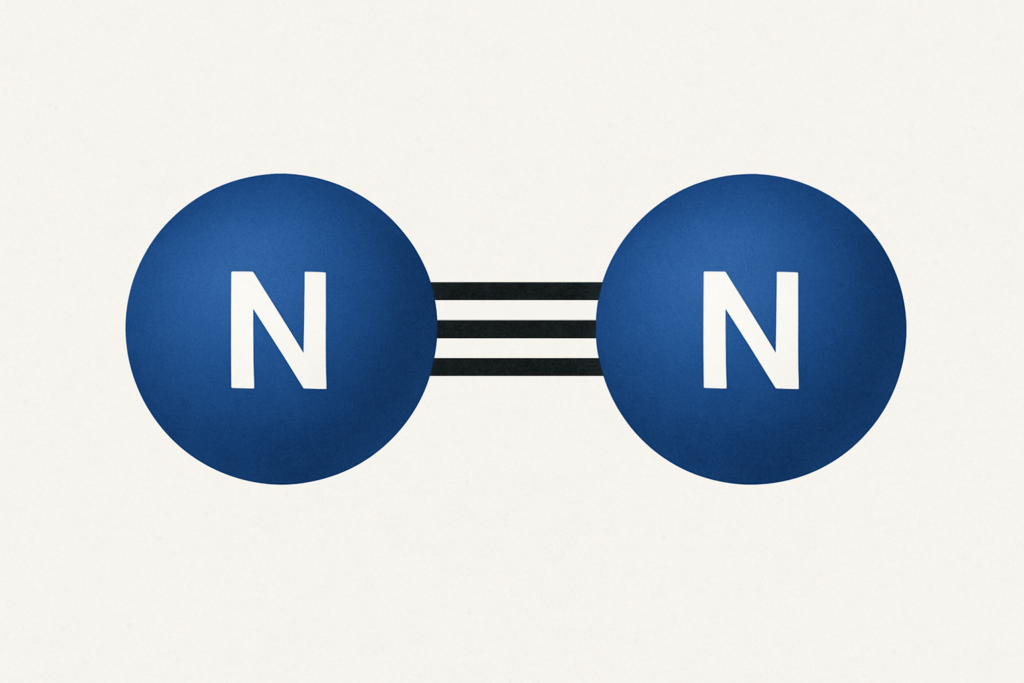
Gaseous nitrogen is the diatomic N₂ gas form of the element nitrogen, a colorless, odorless, and tasteless gas that makes up about 78% of Earth’s atmosphere. At room temperature and pressure, nitrogen exists as a gas composed of very stable N≡N molecules. The strong triple bond in N₂ makes gaseous nitrogen largely inert under normal conditions. It boils at –195.8 °C and freezes at –210 °C, far lower than the corresponding points of oxygen. Because it does not readily react with most substances, gaseous nitrogen is often used to provide an inert (oxygen-free) atmosphere in chemical processes, food storage, and electronics manufacturing. The phrase Gaseous Nitrogen will appear throughout this article to highlight its role in various contexts and to aid searchability.
Common Methods of Preparing Gaseous Nitrogen
Nitrogen gas is typically obtained either by separating it from air or by chemical reactions. The simplest source is ambient air, which is nearly 80% N₂. Industrial-scale production uses physical separation (described below), but small-scale or laboratory methods use chemical reactions. For example, in a chemistry lab one can mix aqueous ammonium chloride (NH₄Cl) with sodium nitrite (NaNO₂) and gently heat the mixture. These react to form unstable ammonium nitrite (NH₄NO₂), which then decomposes into nitrogen gas and water:
NH₄Cl + NaNO₂ → NaCl + N₂↑ + 2 H₂O
This yields essentially pure N₂ gas on a small scale. Another classic method is the thermal decomposition of sodium azide (NaN₃) – used in automobile airbags – which gives sodium metal and nitrogen gas (2 NaN₃ → 2 Na + 3 N₂) almost instantaneously when detonated. These chemical routes produce high-purity N₂ in small quantities and are mainly used for demonstrations or specialized applications. In contrast, large quantities of gaseous nitrogen are made by separating it from air using physical processes.

Table: Comparison of Nitrogen Production Methods
The table below summarizes the main methods, their typical purity, scale, and uses:
| Method | Typical Purity | Scale | Key Features/Uses |
|---|---|---|---|
| Cryogenic air distillation | Up to ~99.999% | Very large (industrial) | Very high purity; large volumes via liquefaction of air |
| Pressure Swing Adsorption (PSA) | 95–99.999% | Medium (industrial) | On-site generators; continuous N₂ production by adsorbing O₂ |
| Membrane separation | ~90–99.5% | Small–medium | Compact units; moderate purity; low maintenance |
| Laboratory chemical reactions | ~100% (small scale) | Small/lab | Pure N₂ from reactions (e.g. NH₄Cl + NaNO₂); e.g., airbags use NaN₃ |
Figure: Diagram of a cryogenic air separation unit. Compressed air is cooled and distilled in high- and low-pressure columns to separate oxygen (O₂), nitrogen (N₂), and argon (Ar). Nitrogen gas exits the top of the column at high purity. Cryogenic plants are large, energy-intensive facilities typically run by gas companies (like Air Liquide or Linde). They often produce not only nitrogen but also liquid oxygen and liquid argon as co-products. The process requires specialized equipment (turbines, heat exchangers, very tall columns) and is most efficient at high scales. Despite the complexity, cryogenic distillation yields vast quantities of gaseous nitrogen for applications demanding very high purity.
Pressure Swing Adsorption (PSA)
In the PSA process, compressed air is passed through vessels filled with carbon molecular sieve (a porous material). Oxygen and some other molecules are preferentially adsorbed onto the sieve under high pressure, allowing the unadsorbed nitrogen to pass through as a product gas. When the sieve becomes saturated with O₂, the pressure is released (swing), and the trapped oxygen is desorbed and vented, regenerating the sieve. The two-stage adsorption/desorption cycles in alternate towers allow for continuous nitrogen generation. PSA units typically produce gaseous nitrogen at 95–99.999% purity, depending on design, and operate at pressures of around 4–7 bar. This method is widely used for on-site generators in industries, laboratories, or smaller plants where high purity (up to 99.99%) is needed but volumes are smaller than cryogenic plants. PSA systems are more compact and simpler than cryogenic plants and consume less energy at medium scales.

Figure: Schematic of a PSA nitrogen generator. Clean compressed air is fed into one of two adsorber towers containing carbon molecular sieve (CMS). Tower A adsorbs oxygen (yielding nitrogen gas), while Tower B is being regenerated by depressurization. The towers alternate to provide a steady output of nitrogen. The PSA method is ideal for point-of-use gaseous nitrogen production. It eliminates the need for liquid oxygen or external N₂ delivery, reducing logistic costs. High-purity nitrogen (suitable for electronics, food packaging, pharmaceuticals) can be obtained simply by adjusting the cycle times and pressures. Maintenance is moderate – primarily replacing adsorbent beds – and the equipment footprint is relatively small.
Membrane Separation
Polymeric membrane systems are another on-site method to generate gaseous nitrogen. Compressed air is driven through hollow-fiber or flat-sheet membranes that allow gas to pass at different rates. Oxygen molecules permeate through the membrane faster than nitrogen, so one side becomes enriched in O₂ (and is vented), while the other side yields nitrogen-rich gas. Membrane generators can produce 90–99.5% pure N₂, typically toward the lower end for compact units. While they cannot reach the ultra-high purity of cryogenic or PSA, membrane units are inexpensive, quiet, and require minimal maintenance (no moving parts). They are suited for applications like inerting or packaging where ~95% purity suffices.
Applications of Gaseous Nitrogen
Gaseous nitrogen’s inertness and availability make it valuable in many fields. Common applications include:
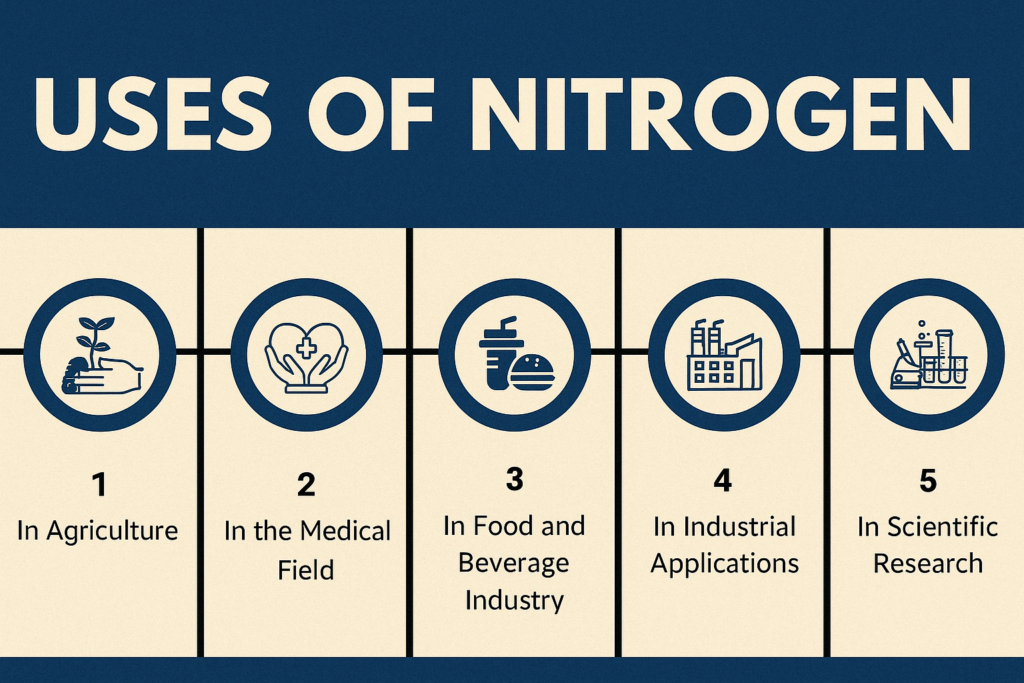
- Food and Beverage Industry: Nitrogen is used in modified-atmosphere packaging (MAP) to displace oxygen and extend shelf life of snacks, meats, and dairy. It is also used to purge and pressurize food processing equipment to prevent oxidation or fire.
- Electronics Manufacturing: A nitrogen atmosphere is used during soldering or semiconductor fabrication to prevent oxidation. Many solder reflow ovens and wave-solder machines use N₂.
- Metallurgy and Heat Treatment: Inert nitrogen gas shields metals (like steel or alloys) during annealing and soldering processes, preventing oxidation or unwanted reactions at high temperatures.
- Chemical and Pharmaceutical Industry: Nitrogen provides a non-reactive blanket in tanks and reactors to avoid explosive or degradative reactions with oxygen. It is also a feedstock for the Haber process to produce ammonia (NH₃).
- Oil & Gas: Nitrogen is used for line purging, pipeline drying, and pressure-testing equipment. It can be injected into oil reservoirs for enhanced recovery.
- Fire Suppression and Safety: In enclosed systems, nitrogen can reduce oxygen levels to suppress fires (inerting). Specialty systems use N₂ to rapidly quench fires in data centers or museums.
- Tire Inflation: Filling aircraft or racing tires with pure nitrogen (instead of air) leads to more stable pressure and less corrosion, because N₂ has less moisture and fewer temperature effects.
- Laboratory and Analytical Use: Ultra-pure N₂ is used as a carrier gas in gas chromatography and as a purge gas in mass spectrometers. Liquid nitrogen (the cryogenic form) is used for cryopreservation, freeze-drying, and cooling (its gas form arises from venting).
In general, anywhere an oxygen-free environment or a dry, inert gas is needed, gaseous nitrogen is the default choice due to safety, cost, and availability.
Safety Precautions for Gaseous Nitrogen
While nitrogen gas is non-toxic and non-flammable, it poses safety risks if mishandled. Key precautions include:
- Asphyxiation Hazard: Because nitrogen is odorless and colorless, N₂ leaks can displace oxygen in confined spaces without warning. Breathing air with less than ~19.5% oxygen can cause dizziness, unconsciousness, or death. Always use adequate ventilation or oxygen monitors in areas with high N₂ use. Do not enter enclosed spaces (tanks, labs) with potential N₂ buildup without proper safety checks.
- Proper Equipment and Regulators: Always secure compressed-gas cylinders upright and use correct high-pressure regulators and fittings. Never attempt to adjust valves with bare hands; use tools. Check connections for leaks with soapy water. Transport cylinders on approved carts or with restraints. When using cylinder [22] regulators and valves, open valves slowly and stand to the side. Always close the valve when the cylinder is not in use.
- Pressure and Mechanical Safety: Nitrogen is typically stored under high pressure (gas cylinders up to 200–300 bar). Never exceed specified pressures, and do not tamper with safety relief devices. Use pressure-relief valves on storage vessels. If a cylinder or tank is overpressurized, it can rupture violently. Do not heat cylinders or expose them to fire or sunlight.
- Cryogenic Burns (if handling liquid N₂): Liquid nitrogen or cold gas can cause severe frostbite. Wear insulated gloves, face shield, and safety goggles when handling cryogenic liquid or cold gas plumes. Ensure containers vent properly to prevent pressure buildup from boiling liquid.
- Training and Labels: Ensure personnel are trained in inert-gas safety. Label all N₂ cylinders and piping clearly. Never assume a green (air) cylinder is oxygen; color codes vary by region. Use the phrase “Nitrogen – Non-toxic, Non-flammable” in labels or signage to inform handlers.
- General Good Practices: Store N₂ cylinders away from flammable materials. Use safety cages or chains to prevent tipping. For large systems, install oxygen sensors in work areas. In case of leak, ventilate the area before re-entering.
Taking these steps ensures that gaseous nitrogen is handled safely. Remember that the main danger from N₂ is simply the lack of oxygen for breathing.
Figure: A compressed nitrogen gas cylinder with regulators and safety valves. Properly secured cylinders and regulators are essential for safe handling of high-pressure nitrogen.
Storage and Transportation of Gaseous Nitrogen
Nitrogen is stored and transported either as a high-pressure gas or as a cryogenic liquid (liquid nitrogen, LN₂). Typical methods include:
- Compressed Gas Cylinders: For moderate volumes, N₂ is stored in steel or aluminum cylinders (or bundles of cylinders). These are high-pressure vessels (usually 150–300 bar). Cylinders must be stored upright, in well-ventilated areas, and kept below heat sources. A suitable regulator reduces pressure for end use. Portable Dewars (vacuum-insulated flasks) may be used for small amounts of liquid nitrogen or cold gas, but they have limits on pressure.
- Large Storage Tanks (Cryogenic): Industrial facilities often use large vacuum-insulated tanks to store liquid nitrogen. These tanks have pressure-relief valves and insulation to keep LN₂ below –196 °C. Because 1 liter of liquid N₂ vaporizes to about 700 liters of gas, these tanks provide a compact way to store large amounts of gas. The photo below shows a typical LN₂ storage tank with frost forming on the cold lines.
Figure: Liquid nitrogen storage tank at an industrial facility. The cryogenic tank is heavily insulated; vaporizing liquid nitrogen escapes as a fog. Large-scale nitrogen is often stored and transported in such vacuum-insulated tanks.
- Transportation: When moving nitrogen offsite, cryogenic liquids are carried in specialized tanker trucks or ISO containers (for LN₂), and compressed gas is moved in tube trailers or cylinder trucks. All containers must comply with regulations for non-flammable gases (usually Class 2.2 in transport). During transit, tanks are kept upright and secured. Pressure-relief valves vent excess gas to prevent overpressure.
- Pipelines: In some industrial complexes (e.g., chemical plants or laboratories in a campus), nitrogen is piped in through a network from a central generator or storage. Piping systems include check valves and regulators, and they are labeled to distinguish nitrogen from other gases.
- Inventory Control: Facilities track cylinder or tank inventories carefully. Empty and full cylinders should be segregated. Only approved transfers (e.g. decanting into smaller cylinders via manifold) are done, with proper purging and flow control.
By following recommended storage and transport practices, industries ensure a reliable gaseous nitrogen supply. Properly maintained cylinders, tanks, and pipelines minimize leaks and hazards, ensuring that nitrogen is available where needed without compromising safety.
Conclusion
The preparation of gaseous nitrogen is essential for both industrial and laboratory applications, with methods ranging from simple chemical reactions to advanced techniques like cryogenic distillation, PSA, and membrane separation. Its abundance, inertness, and versatility make it invaluable across industries—from food preservation and electronics to metallurgy and pharmaceuticals. However, safe handling, storage, and transportation are equally important to prevent risks such as asphyxiation or high-pressure hazards.
Sources
- Hutchinson, G. L., and Eric A. Davidson. “Processes for production and consumption of gaseous nitrogen oxides in soil.” Agricultural ecosystem effects on trace gases and global climate change 55 (1993): 79-93. https://acsess.onlinelibrary.wiley.com/doi/abs/10.2134/asaspecpub55.c5
- Mosier, Arvin R. “Exchange of gaseous nitrogen compounds between agricultural systems and the atmosphere.” Plant and Soil 228.1 (2001): 17-27. https://link.springer.com/article/10.1023/A:1004821205442
- Barker, Allen V., and Gretchen M. Bryson. “Nitrogen.” Handbook of plant nutrition. CRC Press, 2016. 37-66. https://www.taylorfrancis.com/chapters/edit/10.1201/9781420014877-5/nitrogen-allen-barker-gretchen-bryson