
Introduction
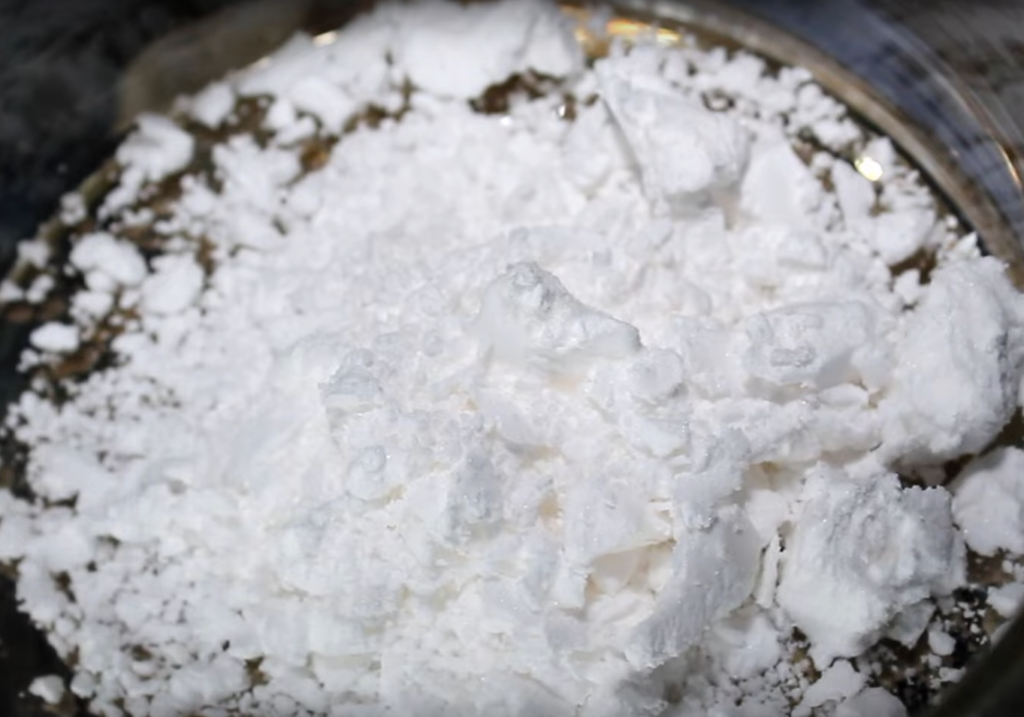
This video tutorial shows chemical nature of acid-base interaction in an example of Saccharin salt. You can observe as Saccharin sodium salt can be easily turned into free acid form by means of simple manipulations.
Theory
An acid is any substance that, when dissolved in water, has a sour taste, alters the color of certain indicators (for example, turning blue litmus paper red), interacts with some metals (such as iron) to release hydrogen gas, reacts with bases to produce salts, and accelerates certain chemical reactions (acid catalysis). Examples of acids include inorganic compounds known as mineral acids, such as sulfuric, nitric, hydrochloric, and phosphoric acids, as well as organic compounds that belong to the carboxylic acid, sulfonic acid, and phenol groups. These substances contain one or more hydrogen atoms that, when in solution, are released as positively charged hydrogen ions (as explained by the Arrhenius theory). Broader definitions of acids, encompassing substances that exhibit typical acidic behavior either in pure form or when dissolved in solvents other than water, are provided by the Brønsted–Lowry theory and the Lewis theory. Examples of non-aqueous acids include sulfur trioxide, aluminum chloride, and boron trifluoride.
An organic acid is an organic compound with acidic characteristics. The most prevalent organic acids are the carboxylic acids, which derive their acidity from the carboxyl group –COOH. Sulfonic acids, containing the group –SO2OH, are notably stronger acids. Alcohols, which contain the –OH group, can also function as acids, though they are generally very weak. The acidity of an organic compound is determined by the relative stability of its conjugate base. Other groups can also impart acidity, usually weakly, such as the thiol group –SH, the enol group, and the phenol group. In biological systems, organic compounds with these groups are commonly referred to as organic acids. Saccharin also possesses an acid H+ proton in =NH group, which make saccharin an organic acid.

Conversion Procedure
- Water 400-500ml and sulfuric acid 40-50% 100ml are prepared;
- Sodium saccharinate is completely dissolved in water.
- Sulfuric acid is added to the solution to an acidic pH.
- Precipitated saccharin is filtered by a Schott filter and dried to a constant weight.
- Saccharin is insoluble in water, so it is washed on a Schott filter with a portion of water.

Conclusion
The Saccharin Salt-Acid Transformation tutorial effectively demonstrates the fundamental principles of acid-base interactions through the example of saccharin sodium salt. By dissolving saccharin sodium salt in water and then adding sulfuric acid to adjust the pH to an acidic level, the transformation to free saccharin acid is achieved. The precipitated saccharin, which is insoluble in water, is then filtered and dried.
This process underscores the core chemical behavior of acids and bases, illustrating how a simple manipulation can convert a salt form into its corresponding acid form.
Bibliography
Oxtoby, David W., H. Pat Gillis, and Laurie J. Butler. Principles of modern chemistry. Cengage AU, 2016. https://books.google.com/books?hl=ru&lr=&id=IQGEDwAAQBAJ&oi=fnd&pg=PP1&dq=Otoxby,+D.+W.%3B+Gillis,+H.+P.%3B+Butler,+L.+J.+(2015).+Principles+of+Modern+Chemistry+(8th+ed.).+Brooks+Cole.+p.+617&ots=16T2WARhyA&sig=E1vfgmNBrvQD-Yjm_6YKJfduttw