

SGT-263 Synthetic Cannabinoid Report: Toxicokinetics, Detection, and Fatal Case Review
Abstract
SGT-263 Trip Report explores the properties of 1-(5-Fluoropentyl)-N-(2-phenylpropan-2-yl)-7-azaindole-3-carboxamide, a newly synthesized cannabinoid, also known as like 5F-CUMYL-P7AICA, that opens up exciting possibilities for research within the realm of chemical supply.
This novel compound targets cannabinoid receptors and serves as a primary active component in numerous synthetic cannabis products.
Toxicokinetics of: SGT-263 A Study Using a Pig Model [1]
Synthetic cannabinoids (SCs) are frequently used as alternatives to cannabis. New variants continually emerge through minor chemical modifications, such as the introduction of a carboxamide moiety as a linker, which may significantly alter their toxicokinetic (TK) profiles. However, available TK data on SCs, particularly those with structural modifications, remain limited, complicating the interpretation of toxicological findings.
SGT-263 is one such modified SC that contains a 7-azaindole core structure and a carboxamide linker. This compound was first identified by the European Monitoring Centre for Drugs and Drug Addiction (EMCDDA) in 2015. Despite regulatory restrictions, slight structural changes like these allow continued circulation of new SCs, which have been associated with serious intoxications and fatalities. Understanding their TK behavior is therefore crucial, especially in forensic contexts such as assessing impairment.
Due to ethical constraints, human studies on SC TK are rare, so researchers rely on alternative models. The pig model has proven valuable given its physiological similarities to humans, including comparable metabolic enzymes and sufficient blood volume for repeated sampling. In this study, SGT-263 was administered to pigs at a dose of 200 µg/kg either intravenously (n=6) or by inhalation (n=10) via ultrasonic nebulizer. Blood samples collected over six hours were analyzed for both the parent compound and its N-pentanoic acid (NPA) metabolite using validated LC–MS/MS methods.
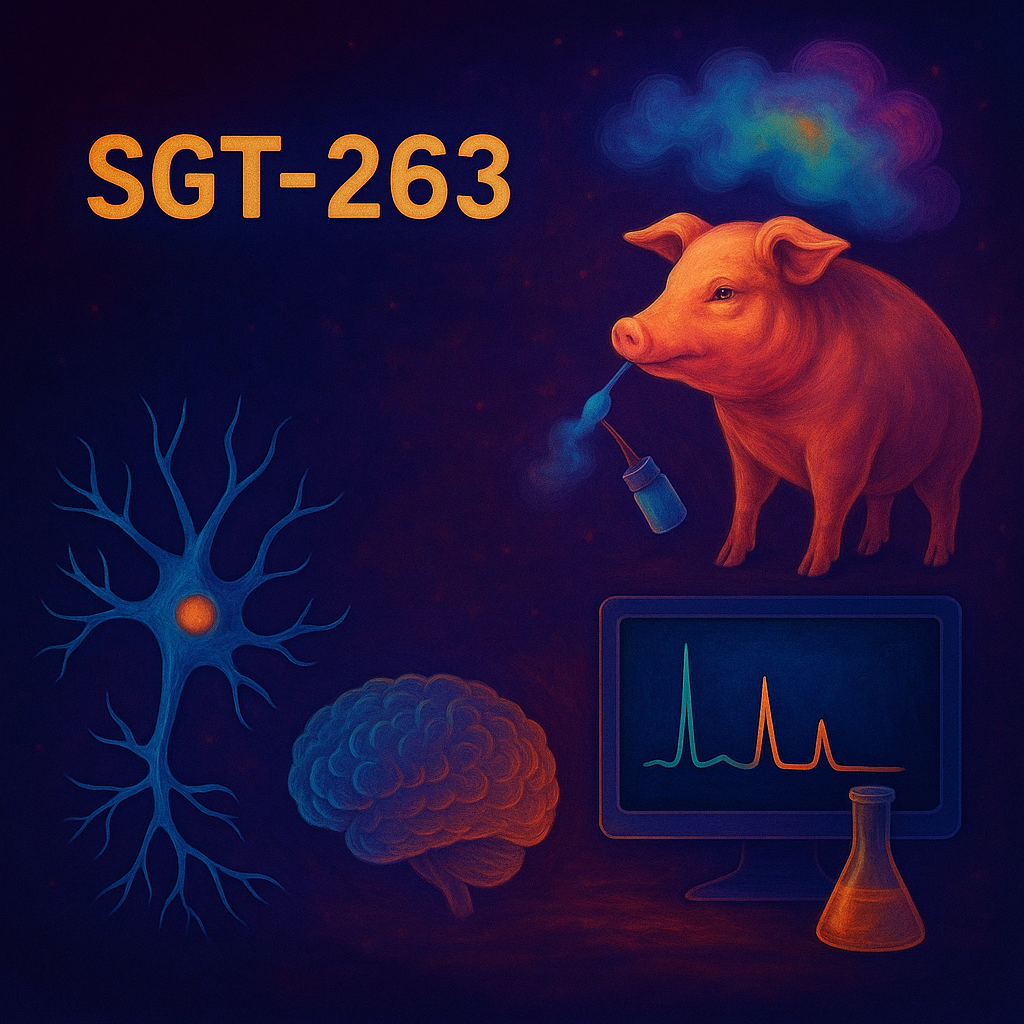
Figure 1. Pig Model.
Population TK analysis of concentration–time data revealed a three-compartment model best describing SGT-263 kinetics, whereas a two-compartment model fit the NPA metabolite. The use of transit compartments accounted for delays in metabolite appearance in serum. Through allometric scaling, the pig-derived model was extrapolated to humans.

Synthetic Cannabinoid News from 2021. SGT-263 Trip Report
Compared to older SCs like JWH-210 and RCS-4, SGT-263 demonstrated a higher volume of distribution, although no other significant differences in TK parameters were found. This suggests that while the insertion of a carboxamide group modifies some TK properties, its overall impact may be limited.
This study advances the understanding of structurally modified SCs and supports better forensic and clinical interpretations by providing robust TK data based on a suitable animal model.
Toxicokinetics and Forensic Detection of SGT-263 [2]
Synthetic cannabinoids (SCs) have emerged as popular cannabis alternatives, with constant structural evolution helping producers evade legal restrictions. One such compound, SGT-263, contains a 7-azaindole core and a carboxamide linker—modifications that may influence its toxicokinetic (TK) behavior and metabolic stability. Despite growing evidence of adverse and fatal outcomes, limited data exist on its in vivo behavior, complicating toxicological interpretation and forensic investigations.
This study provides a multidimensional evaluation of SGT-263 by integrating experimental TK modeling, validated analytical methodology, and application to a real-life fatal intoxication case.
Toxicokinetic Evaluation

Figure 2 Analysis.
Population TK modeling revealed that SGT-263 followed a three-compartment model, while its major metabolite, N-pentanoic acid (NPA), was best described by a two-compartment model. Transit compartments were used to account for time delays in metabolite appearance. Using allometric scaling, human concentration–time profiles were extrapolated. Although SGT-263 exhibited a larger volume of distribution compared to older SCs (e.g., JWH-210, RCS-4), its overall TK properties were only moderately altered by the carboxamide moiety.
Analytical Method Development and Validation
An ultra-high-performance liquid chromatography–triple quadrupole tandem mass spectrometry (UHPLC–QQQ-MS/MS) method was developed and validated for quantifying SGT-263 in biological matrices. Blood, urine, and gastric content samples were extracted using ethyl acetate at alkaline pH (9), with JWH-018-d11 used as the internal standard.
The method demonstrated high sensitivity and reliability:
- Lower limit of quantification (LLOQ): 0.1 ng/mL
- Linearity: r² > 0.9991 (blood), r² > 0.9988 (urine)
- Precision and accuracy: ≤15%
- Recovery: 88–107%
- Matrix effects: 89–119%
Application to a Fatal Intoxication Case. SGT-263 Trip Report
This validated method was successfully applied to a forensic case involving a fatal SGT-263 intoxication in Poland (late 2019). The substance was detected at 2.8 ng/mL in blood and 3.1 ng/mL in urine, while no trace was found in gastric contents. This marks the first fully validated quantification of SGT-263 in authentic human biological specimens linked to a confirmed fatality.
SGT-263 Trip Report: Summary and Insights [3]
Synthetic cannabinoids are a subgroup of new psychoactive substances (NPS) that act as agonists at cannabinoid receptors. Their potency and elimination half-lives vary widely, which may explain why these substances often exhibit greater toxicity than THC. The 2018 European Drug Report indicated that synthetic cannabinoids dominated the NPS market, representing 45% of all drug seizures in 2016. By late 2017, authorities were tracking 179 different synthetic cannabinoids, according to the European Monitoring Centre for Drugs and Drug Addiction. Although overall lifetime use of synthetic cannabinoids remains relatively low among the general population, elevated consumption has been documented in vulnerable groups such as homeless individuals and incarcerated populations across several European nations.
Figure 3 Synthetic. SGT-263 Trip Report
The compound SGT-263 first emerged in 2015 and was subsequently detected in herbal blend products in Germany during 2016 and 2017. Currently, there is a lack of comprehensive data regarding its pharmacokinetic and pharmacodynamic characteristics. While cases of intoxication involving SGT-263 have been reported in Germany, a direct causal relationship has yet to be firmly established. Structurally, SGT-263 is an isomer of 5F-CUMYL-PINACA, differing mainly in its core ring system: the former contains a 7-azaindole core, whereas the latter features an indazole core. Despite this structural variation, chromatographic techniques allow effective differentiation of the two isomers.
Due to extensive metabolism, the parent synthetic cannabinoids are often barely detectable in biological samples like urine. The scarcity of commercially available metabolite standards and the associated costs have led many laboratories to rely on in vitro models such as human liver microsomes or hepatocyte incubations to generate metabolite profiles for analytical purposes. These in vitro results often align well with metabolic patterns found in human urine samples. Nonetheless, confirmation of such profiles through in vivo studies remains crucial for identifying relevant metabolites for routine toxicological screening. At present, no detailed information exists about the human in vivo metabolism of SGT-263, nor have toxicological cases involving this compound been formally documented.

Mass Intoxication with a Synthetic Cannabinoid. SGT-263 Trip Report
Comparative SGT-263 Trip Report and Toxicity
Chemical Structure and Background
SGT-263 and 5F-CUMYL-PINACA are synthetic cannabinoids belonging to the class of new psychoactive substances (NPS). Both compounds act as potent agonists at cannabinoid receptors CB1 and CB2, which mediate their psychoactive effects. Structurally, they differ mainly in their core heterocyclic rings: SGT-263 features a 7-azaindole core, whereas 5F-CUMYL-PINACA contains an indazole core. The 7-azaindole structure of SGT-263 is less common and the compound itself was first identified on the drug market around 2015. In contrast, 5F-CUMYL-PINACA emerged earlier and has been studied more extensively.
Pharmacological Potency and Receptor Affinity
Both substances exhibit high affinity for the CB1 receptor, responsible for their central nervous system effects. However, studies indicate that 5F-CUMYL-PINACA generally displays greater potency, with reported EC₅₀ values in the low nanomolar range (0.06–0.43 nM), which suggests stronger receptor binding and activation compared to SGT-263. This increased potency may contribute to the higher incidence of severe intoxication cases linked to 5F-CUMYL-PINACA.
Behavioral and Physiological SGT-263 Trip Report
The psychoactive effects produced by both cannabinoids are often much stronger than those of Δ9-tetrahydrocannabinol (THC), the main active ingredient in cannabis. Users commonly report intense euphoria and altered sensory perceptions. However, adverse reactions such as anxiety, paranoia, increased heart rate (tachycardia), and in some cases, acute psychotic episodes have also been documented. Preclinical studies with SGT-263 demonstrated dose-dependent depression of locomotor activity in animal models, with an effective dose (ED₅₀) of approximately 0.45 mg/kg. Moreover, hypothermic effects have been observed, including a notable drop in body temperature (about 6°C decrease at 3 mg/kg in mice), indicating strong central nervous system depression.
Toxicity and Clinical Relevance

Figure 4. Collation. SGT-263 Trip Report
Among the two compounds, 5F-CUMYL-PINACA is more frequently associated with severe intoxications and fatal overdoses reported in various countries. Its higher potency and widespread use contribute to a growing number of emergency cases. In contrast, there is a paucity of clinical data regarding SGT-263, with limited toxicological reports and unclear risk profiles. The lack of comprehensive pharmacokinetic and pharmacodynamic data for SGT-263 complicates efforts to fully assess its safety and potential harm to users.
In summary, while both SGT-263 and 5F-CUMYL-PINACA are synthetic cannabinoids with strong psychoactive properties, 5F-CUMYL-PINACA is generally more potent and better studied, with a clearer association with toxic effects. Conversely, SGT-263 remains less understood, requiring further research to elucidate its pharmacology and toxicity. Understanding these differences is crucial for forensic and clinical toxicologists, as well as policymakers aiming to control and mitigate the risks associated with synthetic cannabinoid use.
SGT-263 Trip Report Conclusion
SGT-263 (5F-CUMYL-P7AICA) is a synthetic cannabinoid with limited available data regarding its pharmacological effects, metabolism, and toxicity. Although preclinical studies suggest potent central nervous system activity, comprehensive human studies and real-world reports remain scarce. The lack of confirmed trip reports or clinical documentation underscores the need for further investigation into its safety profile.
Bibliography
- Walle, N., Dings, C., Zaher, O. et al. Does a carboxamide moiety alter the toxicokinetics of synthetic cannabinoids? A study after pulmonary and intravenous administration of cumyl-5F-P7AICA to pigs. Arch Toxicol 99, 633–643 (2025). https://doi.org/10.1007/s00204-024-03906-z https://link.springer.com/article/10.1007/s00204-024-03906-z#citeas
- Zawadzki, M., Chłopaś-Konowałek, A., Nowak, K. et al. Quantification of 5F-CUMYL-P7AICA in blood and urine from an authentic fatality associated with its consumption by UHPLC–MS/MS. Forensic Toxicol 39, 240–247 (2021). https://doi.org/10.1007/s11419-020-00555-6 https://link.springer.com/article/10.1007/s11419-020-00555-6#citeas
- Sandra N. Staeheli, Andrea E. Steuer, Thomas Kraemer Identification of urinary metabolites of the synthetic cannabinoid 5F-CUMYL-P7AICA in human casework https://doi.org/10.1016/j.forsciint.2018.11.002 https://www.sciencedirect.com/science/article/abs/pii/S0379073818304523?via%3Dihub
- https://en.wikipedia.org/wiki/5F-CUMYL-P7AICA#cite_note-7