
Synthesis of Testing Reagents for Drug Identification
Introduction
This guide serves as a supplementary resource to our comprehensive article on the materials and methods used in the identification of psychoactive substances (PAS) through Testing Reagent. It is intended for both professionals and general readers interested in chemical spot tests used for drug screening.
Marquis Testing Reagent
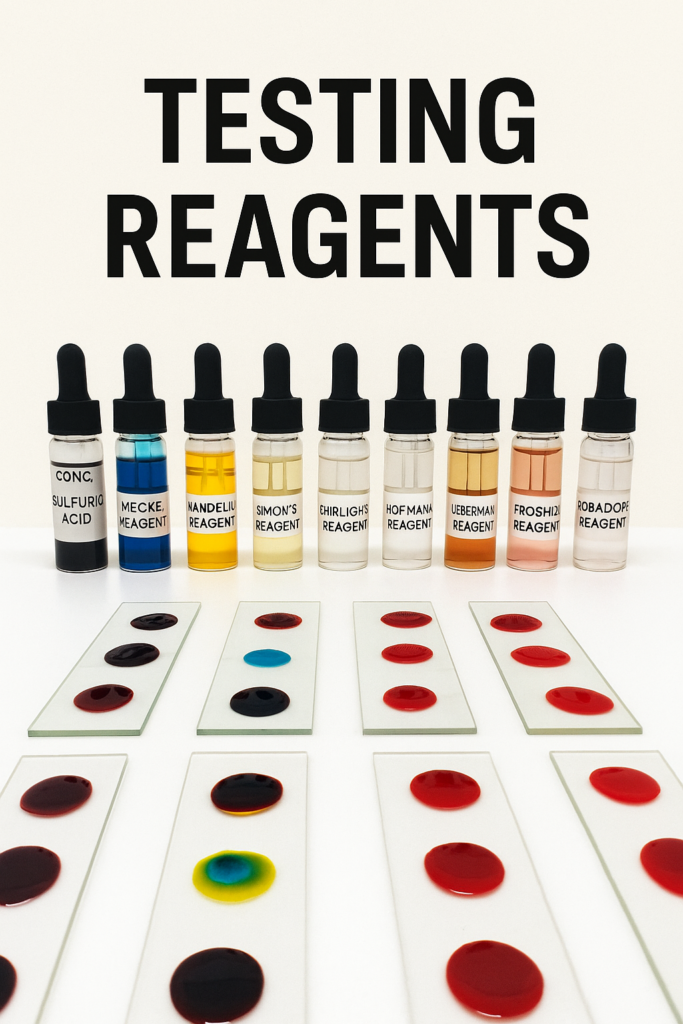
To prepare the Marquis reagent, carefully pour 50 mL of concentrated sulfuric acid (95–98%) into 10 mL of 37% formaldehyde solution. Important: Always add the acid to the formaldehyde, never the other way around, to prevent hazardous reactions. If using 40% formalin instead, combine 5 mL of it with 100 mL of concentrated sulfuric acid. Initially, this Testing Reagent appears clear, but over time, it will darken to black. This color shift does not compromise its reactivity.
Mecke Testing Reagent
The Mecke reagent is formulated by dissolving 0.25 g of selenous acid (or alternatively, 0.34 g of sodium selenite) into 25 mL of concentrated sulfuric acid. Dissolution is not immediate and may require time and gentle agitation. The freshly prepared Testing Reagent is transparent, although it gradually darkens with age, which does not affect its efficacy.
Mandelin Testing Reagent
To synthesize the Mandelin reagent, dissolve 1 gram of ammonium metavanadate in 100 mL of concentrated sulfuric acid. The resulting Testing Reagent has a characteristic orange hue, which will slowly transition to yellow over time. This color change is normal and does not impact its function in drug testing.
Simon’s Testing Reagent (Two-Part System)
This reagent is comprised of two separate solutions:
- Solution A: Prepare by mixing equal parts of 1% sodium nitroprusside (in distilled water) and 10% acetaldehyde (also in water). For example, dissolve 1 g of sodium nitroprusside in 100 mL of water, and mix 10 mL of acetaldehyde with 90 mL of water. Combine 10 mL of each to form the working solution.
- Solution B: Create a 2% sodium carbonate solution by dissolving 2 g of sodium carbonate in 100 mL of distilled water.
For use, apply one drop of Solution A to the substance being tested, followed by one drop of Solution B. This Testing Reagent is sensitive to secondary amines.
Ehrlich’s Testing Reagent
To make Ehrlich’s reagent, dissolve between 0.5 to 2 grams of p-dimethylaminobenzaldehyde (p-DMAB) in a mixture of 50 mL of 95% ethanol and 50 mL of concentrated hydrochloric acid (38%). This Testing Reagent is commonly used for detecting indole alkaloids such as LSD and tryptamines.
Hofmann (Van Urk-Salkowski) Reagent
Prepare this reagent by cooling a solution of 65 mL concentrated sulfuric acid in 35 mL water. To this, add 0.125 g of p-DMAB and stir until fully dissolved. Then add 1–2 drops of a ferric chloride solution (made by dissolving 9 g FeCl₃ in 100 mL water). This Testing Reagent is particularly useful for identifying tryptamines and ergoloids.
Liebermann Reagent
Combine 1 g of potassium nitrite with 10 mL of concentrated sulfuric acid to form the Liebermann reagent. Sodium nitrite can be used as a substitute if potassium nitrite is unavailable. This Testing Reagent is effective for detecting a range of phenethylamines and opiates.
Froehde Testing Reagent
Heat 100 mL of concentrated sulfuric acid (95–98%) and dissolve 0.5 g of sodium molybdate or molybdic acid into it. Allow the mixture to sit for 2 to 4 hours to ensure complete dissolution. The Froehde Testing Reagent is used for differentiating between a variety of drug classes, particularly alkaloids.
Robadope Testing Reagent
This reagent is a modified version of Simon’s reagent, adjusted to detect primary amines rather than secondary amines. It also consists of two components:
- Solution A: Dissolve 1 g of sodium nitroprusside in 50 mL of distilled water, then add 2 mL of acetone.
- Solution B: A 2% sodium carbonate solution (2 g in 100 mL water).
To use, apply one part of Solution A to the test substance, followed by two parts of Solution B. This Testing Reagent is particularly helpful in distinguishing primary amine-based compounds.
Zimmermann Testing Reagent
This reagent comprises two components:
- Component 1: A 1% (w/v) solution of 1,3-dinitrobenzene in methanol.
- Component 2: A 15% potassium hydroxide solution in water.
Add one drop of each to the sample, and observe the resulting color reaction. The Zimmermann Reagent is especially effective for identifying benzodiazepines.
By using these Testing Reagents, users can conduct preliminary spot tests to identify various psychoactive substances quickly and efficiently. Proper preparation and handling are essential to ensure accurate and safe testing outcomes.
Conclusion
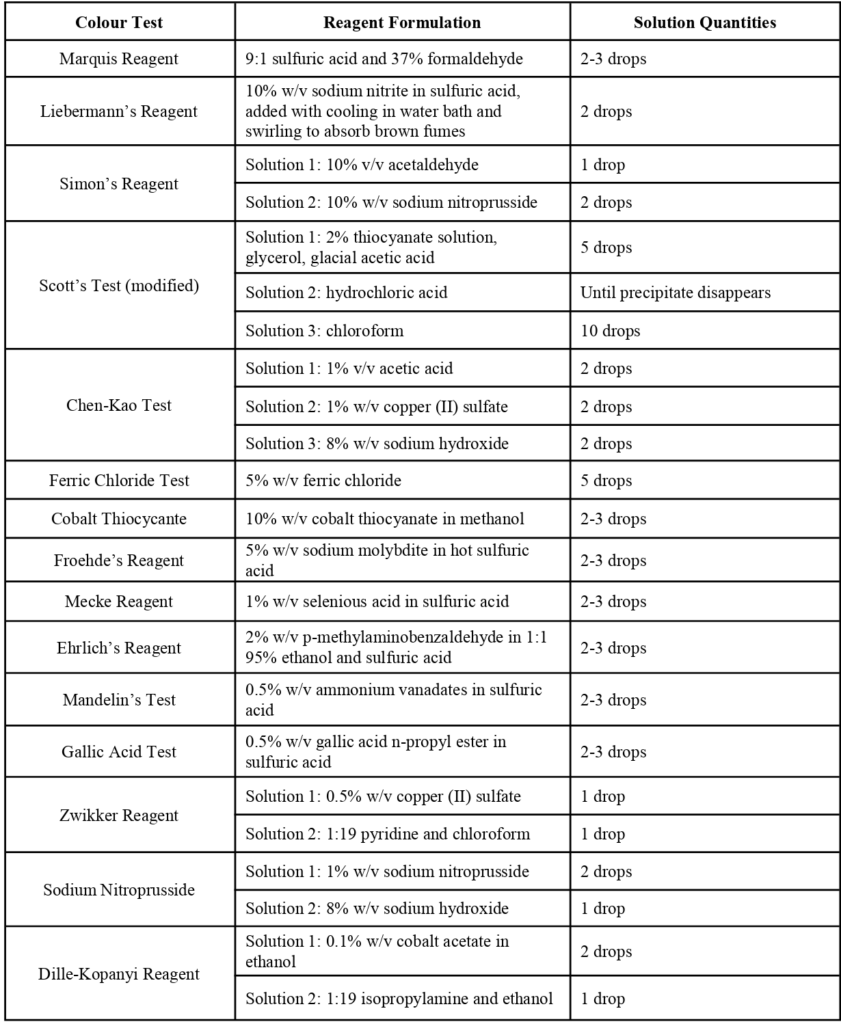
Proper knowledge and application of various Testing Reagents play an important role in the accurate identification of psychoactive substances. Reagents like Marquis, Mecke, Mandelin, and others each produce distinct color reactions that reveal specific chemical characteristics of tested compounds. While these reagents offer a fast and economical way to perform presumptive drug tests, they should always be handled with care and, when possible, supported by advanced analytical techniques for confirmation. Whether used in forensic work, research, or harm reduction, mastering these testing methods significantly improves the reliability of substance analysis.
Sources
- Philp, Morgan, and Shanlin Fu. “A review of chemical ‘spot’tests: A presumptive illicit drug identification technique.” Drug testing and analysis 10.1 (2018): 95-108. https://doi.org/10.1002/dta.2300
- Toole, Kaitlyn E., et al. “Color tests for the preliminary identification of methcathinone and analogues of methcathinone.” Microgram J 9.1 (2012): 27-32. https://www.dea.gov/sites/default/files/pr/microgram-journals/2012/mj9-1_27-32.pdf