

Simon’s Reagent Test
Introduction
The Simon’s reagent (or Simon’s test) is a presumptive spot-test used in forensic and harm-reduction settings to detect secondary amines in a sample. It is most often used as a follow‐up test after others (e.g. Marquis) to help distinguish between similar drugs. In particular, Simon’s reagent turns a blue color in the presence of secondary amines (for example, methamphetamine or MDMA), but not with primary amines (e.g. amphetamine or MDA). Because it is a qualitative test, a positive (blue) result only indicates that a secondary amine is present; it does not confirm identity or purity.
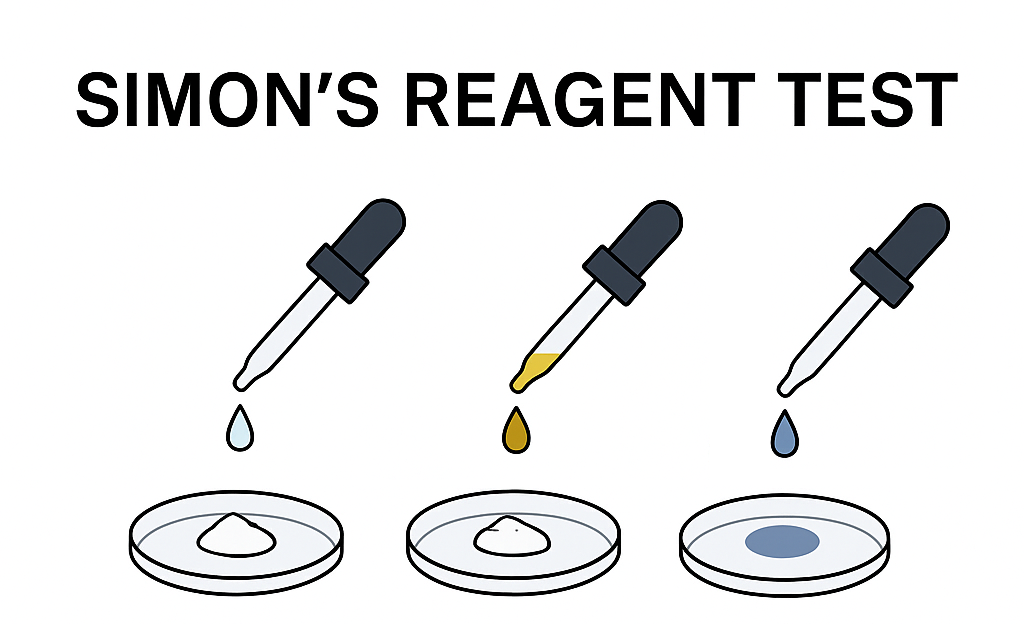
What is Simon’s Reagent?
Simon’s reagent consists of two solutions (often called Solution A and B).
Solution A: Prepare by mixing equal parts of 1% sodium nitroprusside (in distilled water) and 10% acetaldehyde (also in water). For example, dissolve 1 g of sodium nitroprusside in 100 mL of water, and mix 10 mL of acetaldehyde with 90 mL of water. Combine 10 mL of each to form the working solution.
Solution B: Create a 2% sodium carbonate solution by dissolving 2 g of sodium carbonate in 100 mL of distilled water.
For use, apply one drop of Solution A to the substance being tested, followed by one drop of Solution B. This Testing Reagent is sensitive to secondary amines. The two-part reagent must be kept separate (to prevent aldol condensation of the aldehyde) and mixed only when testing.
Chemically, when the two solutions are added to a sample containing a secondary amine, the acetaldehyde first reacts with the amine to form an enamine. This intermediate then reacts with nitroprusside to form a colored iminium ion, which is hydrolyzed to a bright blue complex (sometimes called the “Simon‐Awe” complex). In contrast, a primary amine does not form the same enamine with acetaldehyde, so no blue color appears under normal Simon’s test conditions. (If one substitutes acetaldehyde with acetone in the reagent, the test instead becomes responsive to primary amines, yielding a purple color – a different variant sometimes used to target amphetamines, but it is more prone to false positives.)
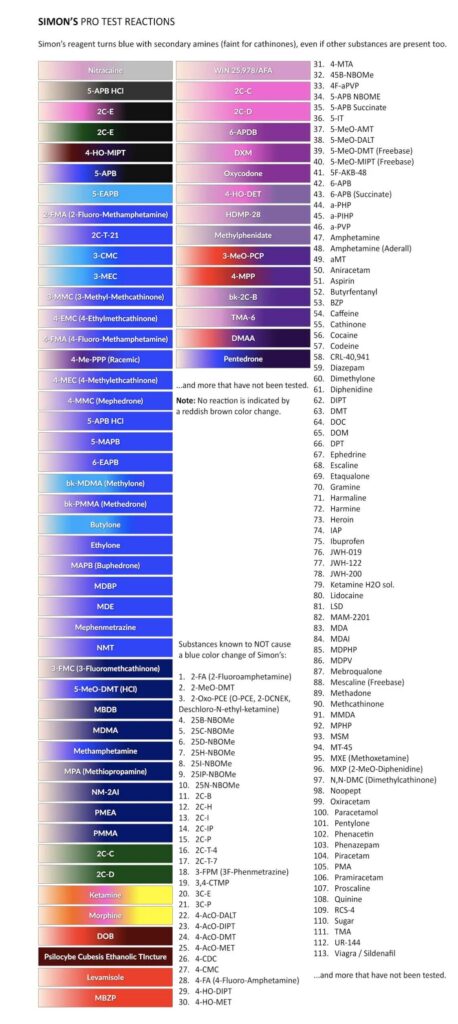
Simons’s reagent is commonly used in drug-testing kits to differentiate MDMA vs. MDA or methamphetamine vs. amphetamine, since MDMA and methamphetamine are secondary amines (blue), whereas MDA and amphetamine are primary (no color). In practice, it is applied after a preliminary test (like Marquis) to narrow down the possibilities.
Simon’s Reagent Test Step-by-step Experiment
The Simon’s reaction is a qualitative reaction that is used to detect secondary amines.

To carry out Simon’s reaction, three reagents should be prepared:
Reagent 1: dissolve of sodium carbonate 2g in water 100ml (2% aqueous solution of sodium carbonate).
Reagent 2: dissolve sodium nitroprusside 1g in water 100ml (1% aqueous solution of sodium nitroprusside).
Reagent 3: mix acetaldehyde solution 10ml and ethanol 10ml (50% ethanol acetaldehyde solution).
Acetaldehyde solution can be prepared from ethanol by dropping a red-hot copper wire into acetaldehyde until the characteristic smell of acetaldehyde appears.
- 1. To carry out Simon’s reaction, the test sample is placed on a watch glass.
- 2. An aqueous sodium bicarbonate solution drop is added to the sample in order to make alkaline pH.
- 3. Then, a drop of sodium nitroprusside aq. solution is added.
- 4. Next, a drop of acetic aldehyde solution in ethanol (1:1) is added. The blue color appearance is a sign that only methamphetamine is presented in the sample. Color saturation indicates the concentration of amine in the sample. The lighter the color, the less amine is in the sample.
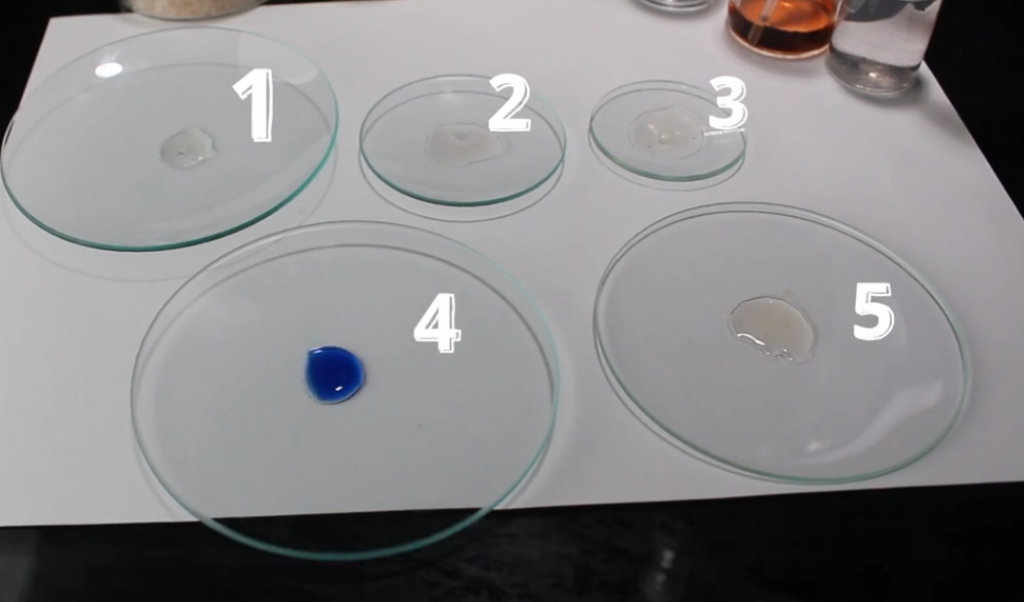
Samples #1, #2 and #3 are ephedrine. Ephedrine did not give a characteristic blue color. Sample #4 – methamphetamine gave a characteristic blue color.
Sample #5 is methcathinone. It can gives a light blue color, but did not give a reaction because it is not too specific.
Simon’s reagent reacts with amines such as MDMA, methamphetamine, etc.
Simon’s Reagent Test Note
This qualitative reaction is not suitable for testing amphetamine, but, using this reaction, it is possible to distinguish amphetamine from methamphetamine. Amphetamine and substituted in the aromatic ring amphetamines (DMA, TMA, MMDA, etc.) do not give a characteristic color. If acetaldehyde is replaced with acetone in Simon’s reagent, then amphetamine and other substituted amphetamines give a dark red (purple) color under the same conditions. However, this reaction is not specific enough, since some other substances can give the same color.
You can also buy a ready-made Simon’s reagent if you don’t want to prepare the reagents by yourself.
Next, we will show a table with the results of color reactions with Simon’s reagent.
In some cases, the reaction may fail if the sample is not too specific*.
Conclusion
Simon’s reagent is a simple qualitative test for identifying the presence of secondary amine compounds in seized samples. It works via the formation of a blue enamine-nitroprusside complex when a secondary amine is present. This makes it valuable for distinguishing, for example, methamphetamine from amphetamine, or MDMA from MDA, in the field. The test is rapid and easy to perform with minimal equipment, but it is not definitive: other substances can interfere, and it does not measure quantity or purity. For best practice, Simon’s test should be used in combination with other reagents (and ideally laboratory analysis) to confirm drug identity. Despite its limitations, the characteristic blue color reaction remains a useful forensic indicator of secondary amines.
Sources
- Saito, Koichi, et al. “An improved Simon reaction method to discriminate between methamphetamine and false‐positive substances.” Journal of forensic sciences 69.3 (2024): 1021-1024. https://onlinelibrary.wiley.com/doi/abs/10.1111/1556-4029.15492
- Sushma, K., Somsubhra Ghosh, and David Banji. “Role of chemical and analytical reagents in colorimetric estimation of pharmaceuticals-a review.” International Journal of Medicine and Pharmaceutical Research 1.5 (2013): 433-445. https://www.researchgate.net/profile/Somsubhra-Ghosh/publication/308022428_Role_of_chemical_and_analytical_reagents_in_Colorimetric_estimation_of_Pharmaceuticals_-_a_Review/links/57d6e97908ae601b39ac2536/Role-of-chemical-and-analytical-reagents-in-Colorimetric-estimation-of-Pharmaceuticals-a-Review.pdf
- Alonzo, Morgan, et al. “Portable testing techniques for the analysis of drug materials.” Wiley Interdisciplinary Reviews: Forensic Science 4.6 (2022): e1461. https://wires.onlinelibrary.wiley.com/doi/full/10.1002/wfs2.1461
- Drug Testing Reagents https://bbgate.com/threads/drug-testing-reagents.27/
- https://wikipedia.org