
Drug Testing Reagents: A Guide to Identifying Substance Adulteration
Introduction
This Drug Testing Reagents guide was inspired by a troubling incident where a laboratory analysis revealed a drug sample labeled as high-quality amphetamine actually contained 72% α-PVP and 18.5% caffeine. Such a substitution isn’t always intentional—dealers or couriers may simply mix up samples. However, the consequences can be severe. Since α-PVP is active at much lower doses than amphetamine, using a typical dose could easily result in overdose and hospitalization.
Unfortunately, cases like this are far from rare. Another amphetamine sample was tested and found to contain 34% amphetamine, 36% caffeine, and 19% α-PVP. These are not isolated events. Many similar substitutions—whether intentional or accidental—go undetected. Substances like α-PVP, methadone, or other potent psychoactives are sometimes substituted for more common drugs such as amphetamine or mephedrone, without the user’s knowledge.
Given these risks, it’s critical to be able to identify what’s really in a substance before consumption. This is where drug testing reagents play an essential role. These chemical tools can help users, harm reduction workers, and researchers uncover hidden ingredients in a sample—sometimes with just a single drop.
What Are Drug Testing Reagents?
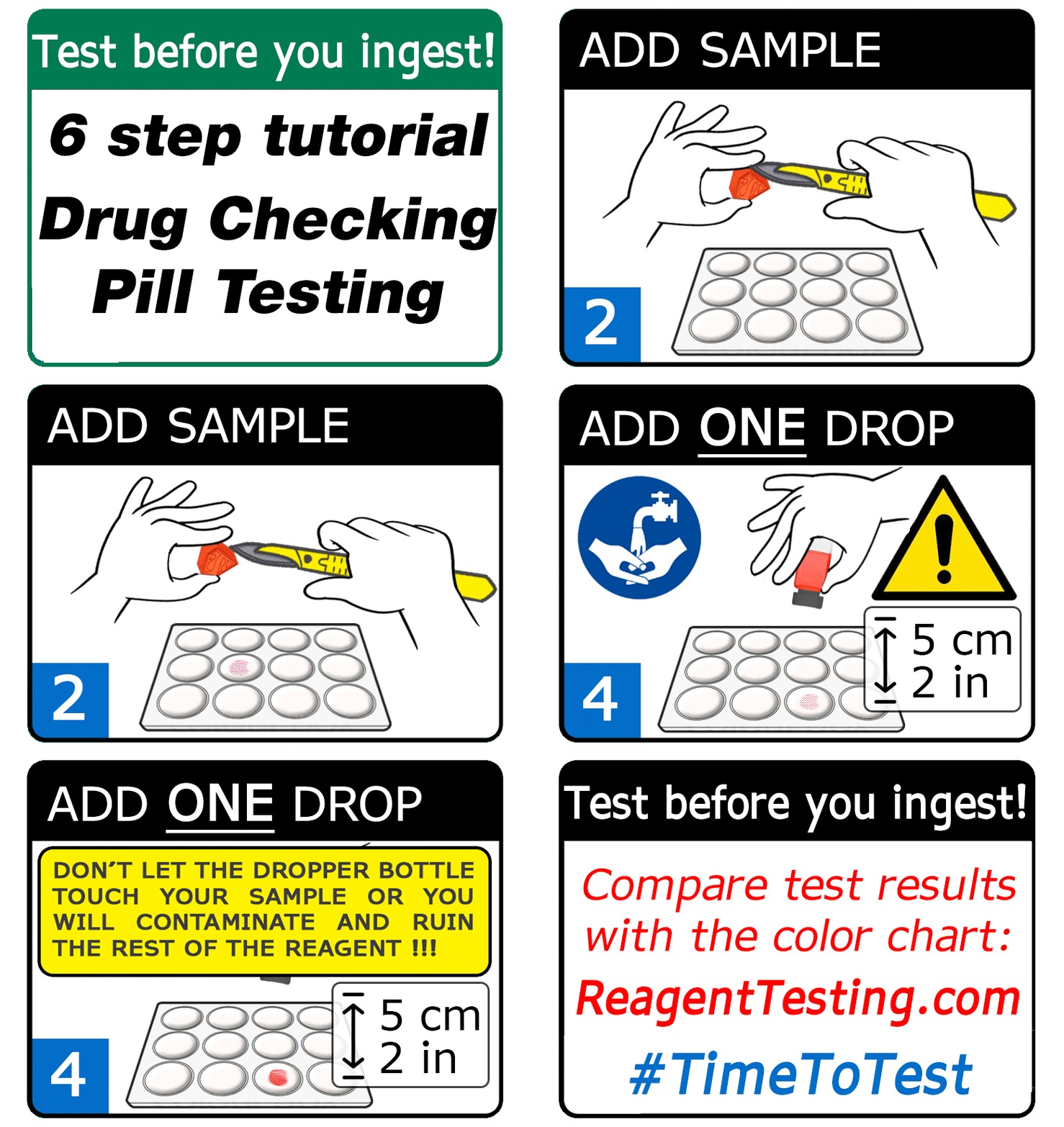
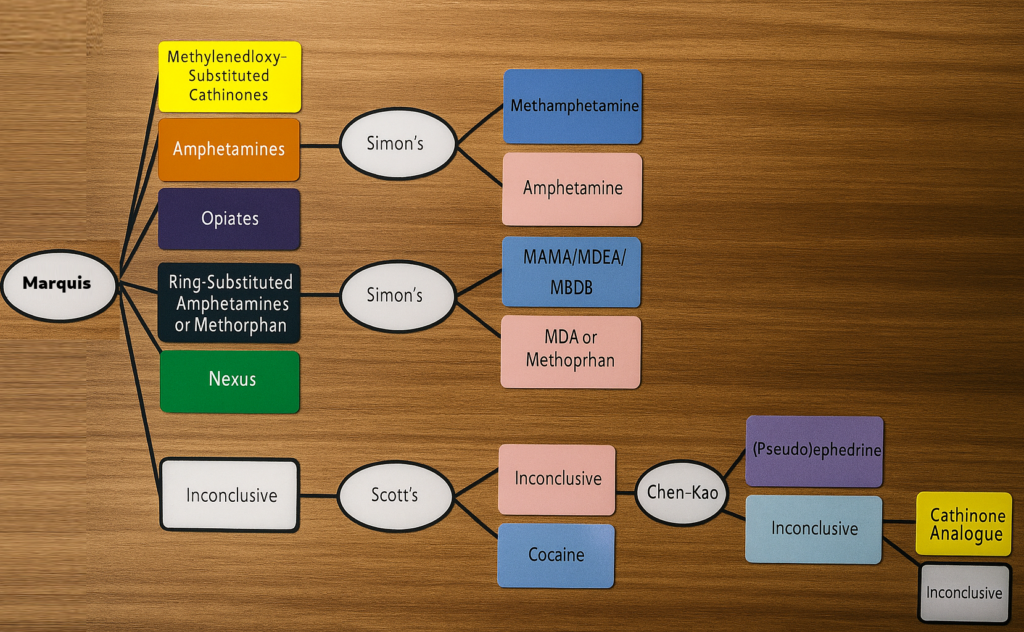
Drug testing reagents are chemical solutions that change color when they react with specific substances. For instance, when amphetamine is tested with the Marquis reagent, the result is typically an orange hue. If the same reagent is used on caffeine, the color does not change. Each reagent is designed to react with a specific group of compounds, and because multiple substances can produce similar color changes, it’s best to use several reagents in tandem.
Generally, using three different reagents can help identify around 90% of known substances. Using five can increase this to 95%. These reagents are completely legal in most countries and are widely used for psychoactive substance (PAS) identification.
The most commonly used testing reagents include:
- Marquis Reagent
- Mecke Reagent
- Mandelin Reagent
- Simon’s Reagent
- Ehrlich’s Reagent
There are more than 10 reagents used in advanced substance testing. Let’s explore a real-world scenario to understand how these reagents work.
Real-World Application: Identifying a-PVP in a Sample
Suppose someone receives what they believe is amphetamine. To confirm the substance’s identity, they can use two key drug testing reagents:
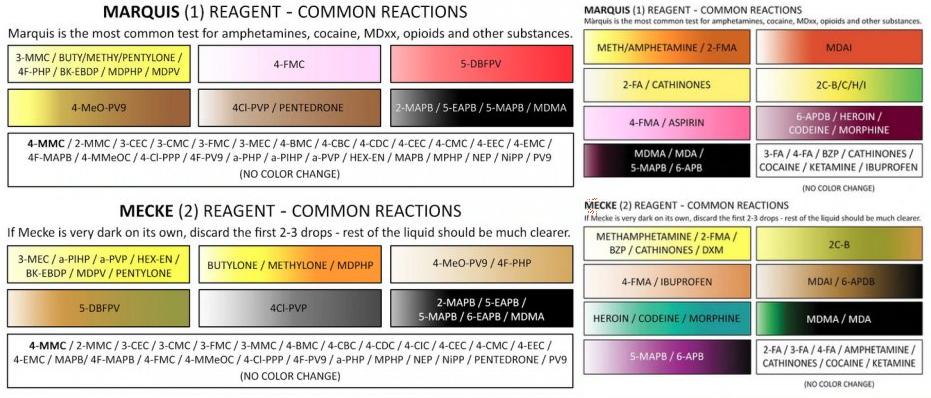
- Marquis Reagent: This will turn orange-brown when exposed to amphetamine or methamphetamine. However, it shows no reaction with α-PVP or mephedrone (4-MMC).
- Mecke Reagent: This produces a yellow reaction with α-PVP, but not with mephedrone. It also helps differentiate amphetamine (no reaction) from methamphetamine (yellow color).
With just a couple of reagents, the user can detect dangerous adulterants like a-PVP or distinguish between closely related substances. There is another way how to determine a-PVP by simple qualitative test.
Advanced Identification Using Reagents
Drug testing reagents can also differentiate among various compounds in the same chemical family. Examples include:
- 2C-B vs. 2C-I
- MDA vs. MDMA
- 25B-NBOMe vs. 25C-NBOMe vs. LSD
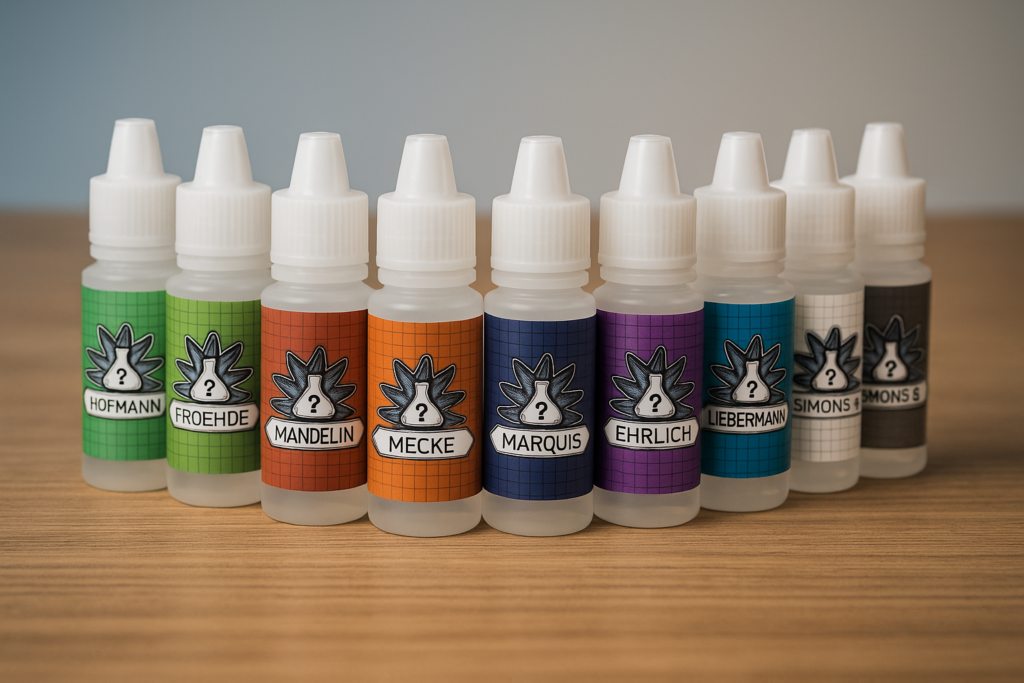
Cocaine adulteration can also be evaluated. For example, one cocaine sample was found to contain 44% benzocaine, a common cutting agent. With the Mandelin reagent, such an impurity would likely produce a yellow-brown result. The Froehde reagent is another useful tool for testing alkaloids and opioids, offering presumptive identification through color reactions.
There are numerous databases and charts that catalog color outcomes for various substances and reagent combinations.

Limitations and Misconceptions
It’s important to remember that drug testing reagents offer qualitative, not quantitative, analysis. They reveal what is present in a sample, but not how much. For instance, a mixture containing equal parts amphetamine and caffeine could produce misleading results. Depending on where the sample is taken from, one compound may dominate the color change, masking the presence of the other.
This limitation is why it’s beneficial to complement reagent testing with laboratory-grade quantitative chemical analysis. In Europe, labs often publish substance profiles on platforms like DrugsData, contributing to a growing database of verified compositions.
Reagents for Semi-Quantitative Testing
While most drug testing reagents provide only qualitative data, some advanced formulations can estimate substance concentration. These reagents change color intensity based on the percentage of the active ingredient. For example, a sample containing 20% MDMA might produce a light blue result, while pure MDMA would turn the reagent dark blue.
However, this method has limitations:
- It’s only semi-quantitative, providing broad percentage ranges (e.g., 0–20%, 20–40%).
- Limited availability—these reagents are currently only available for a few substances like MDMA, heroin, and cocaine.
Despite these constraints, they can still offer valuable insights when used alongside standard reagents.
Where to Buy Drug Testing Reagents
Most drug testing reagents are legal to purchase and use. However, due to the presence of corrosive chemicals (like sulfuric acid), some shipping services may restrict transportation. Reputable vendors often remove labels or documentation that might draw attention to the package contents. Many also offer anonymous payment options like cryptocurrency.
Pricing Overview
- Single reagent (5 mL): $7–$14 (enough for ~100 tests)
- 10 mL bottle: ~200 tests
- Complete testing kits: $27–$41
For those with chemistry experience, some reagents can be synthesized at home using commonly available acids and precursors. That said, extreme caution is advised. A separate article on synthesizing reagents is available here: Synthesis of Testing Reagents.
Final Thoughts
Drug testing reagents offer a powerful tool for identifying the true contents of psychoactive substances. While they don’t replace full-spectrum lab testing, they are invaluable for harm reduction, substance verification, and minimizing the risks of unintentional ingestion of harmful adulterants.
This guide provides a foundation for understanding how these reagents work, what their limitations are, and where to obtain them. For more detailed information—including specific reactions involving LSD, Ehrlich’s reagent, and others—further self-research is encouraged.
Sources
- Philp, Morgan, and Shanlin Fu. “A review of chemical ‘spot’tests: A presumptive illicit drug identification technique.” Drug testing and analysis 10.1 (2018): 95-108. https://analyticalsciencejournals.onlinelibrary.wiley.com/doi/abs/10.1002/dta.2300
- Harper, Lane, Jeff Powell, and Em M. Pijl. “An overview of forensic drug testing methods and their suitability for harm reduction point-of-care services.” Harm reduction journal 14.1 (2017): 52. https://link.springer.com/article/10.1186/s12954-017-0179-5
- O’Neal, Carol L., Dennis J. Crouch, and Alim A. Fatah. “Validation of twelve chemical spot tests for the detection of drugs of abuse.” Forensic Science International 109.3 (2000): 189-201. https://www.sciencedirect.com/science/article/abs/pii/S0379073899002352