

Marquis Reagent Test Experiment
Introduction
Marquis reagent testing is one of the oldest and most widely used presumptive chemical spot-tests for the rapid, on-the-spot screening of unknown powders and pills. It’s inexpensive, fast, and—when used correctly—helpful for harm-reduction or preliminary forensic screening. However, it’s important to remember that Marquis and other color-tests are screening tools only: they can suggest the likely class of a compound, but they cannot definitively identify a substance or measure purity. Confirmatory laboratory methods (GC–MS, LC–MS, IR) are required for legal or clinical certainty.
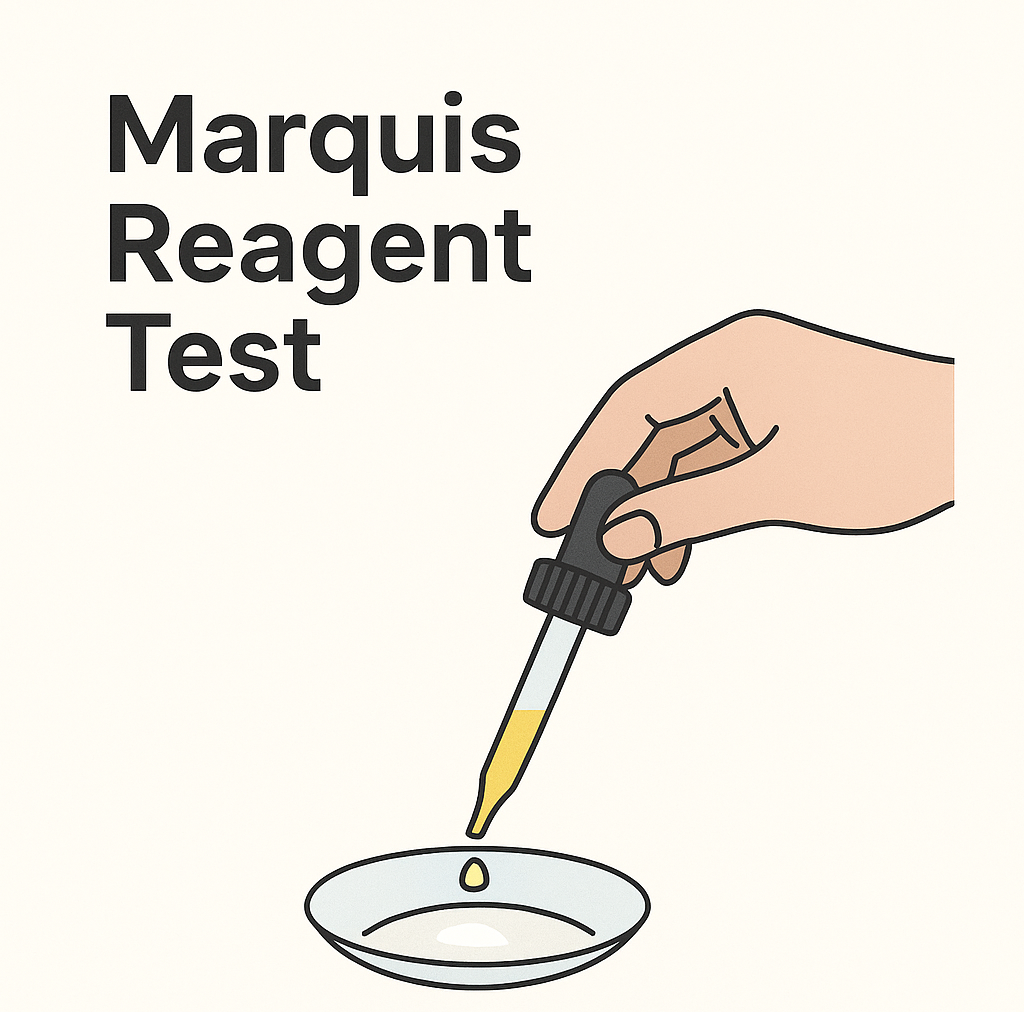
What is Marquis Reagent Test?
The Marquis reagent is an acidified formaldehyde reagent used as a colorimetric spot test. When a tiny amount of an unknown sample is exposed to the reagent, characteristic color changes develop within seconds for many classes of compounds (for example, MDMA/MDA often give dark purple/black; amphetamines often give orange→brown). Because different structural families yield different colors and reaction speeds, the Marquis test is useful as a quick presumptive screen. That said, results can be affected by cutting agents, dyes, and small sample size, and different sources/recipes of “Marquis” can change the exact shade and timing.
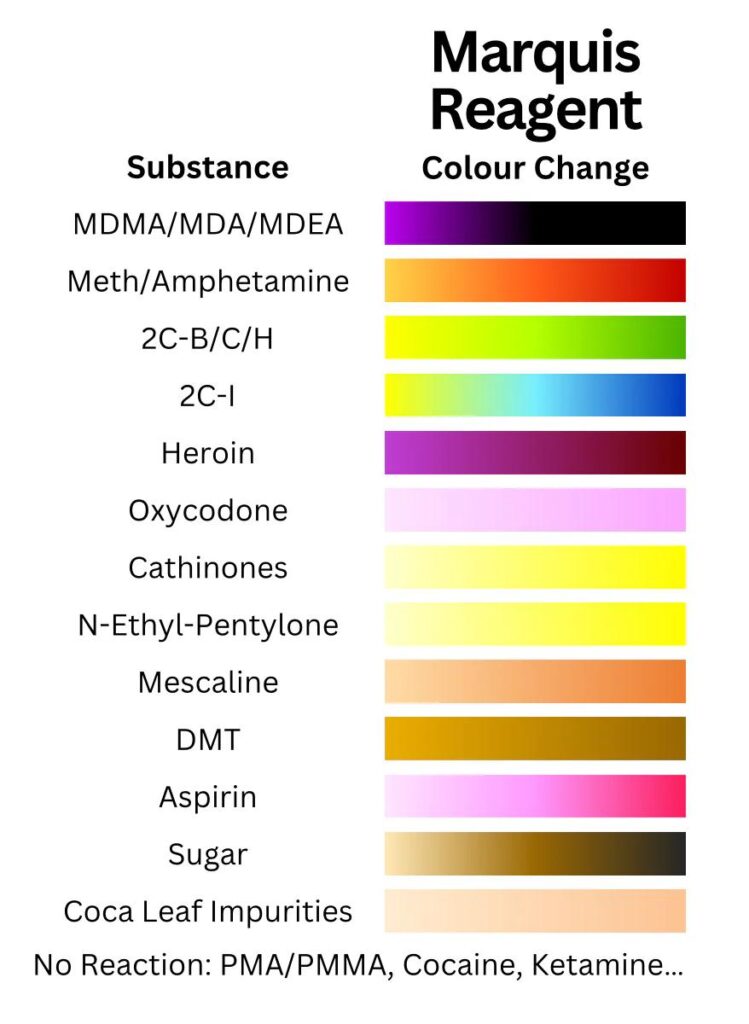
Marquis Reagent Test Step-by-step Experiment

1. Formalin 37% 1 ml is placed into a beaker and oleum 103% 3-5 ml is added drpwise with constant stirring. Oleum is sulphuric acid 100% + SO3 3% dissolved in it.
2. Samples of amphetamine free base, apmhetamine aspartate, methamphetamine hydrochloride are placed on the watch glasses. DCM is evaporated from the solution with free base.
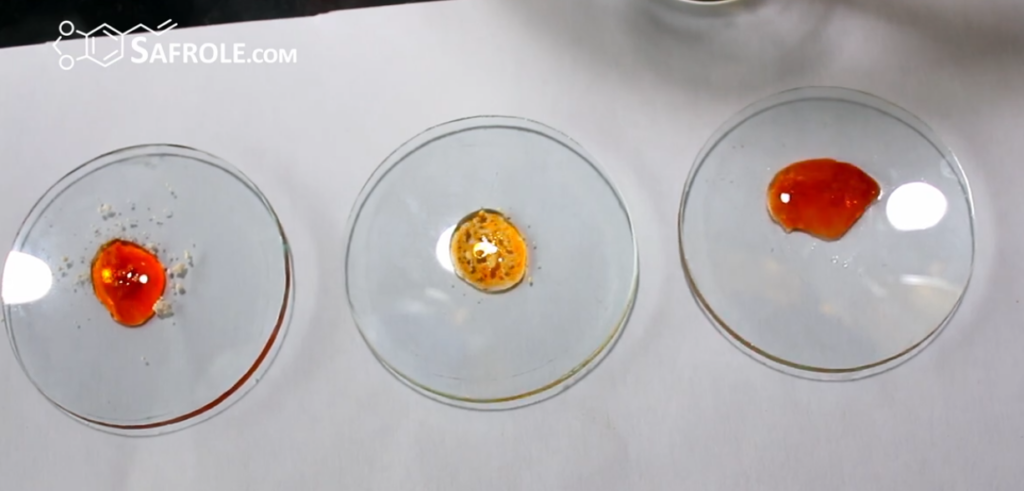
3. Marquis reagent 2-3 drops are added to the samples and their colors are changed. It can be observed within 5 seconds.
MDA hydrochloride, ephedrine hydrochloride are also tested by Marquise Reagent Test. If there is no color appearance after 60 seconds, the reaction is considered as negative.
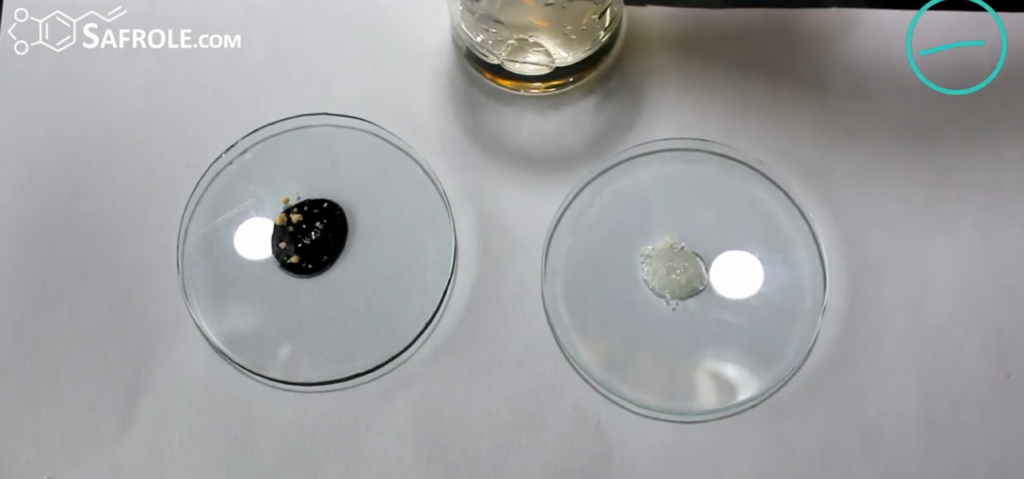
Samples of amphetamine free base, apmhetamine aspartate, methamphetamine hydrochloride and MDA hydrochloride gave positive reactions whereas ephedrine hydrochloride gave negative one.
Important Marquis Reagent Test Limitations to Keep in Mind
Presumptive only: color tests cannot confirm identity or purity. False positives and false negatives occur. Use multiple reagent types (e.g., Marquis + Mecke + Simon’s/Mandelin) for better discrimination and send samples for confirmatory lab testing if accurate identification is required.
Interferences: pill dyes, fillers, or trace adulterants can alter or mask colors. Small sample sizes may miss low-percentage adulterants.
Timing matters: many reactions happen in the first few seconds — you should note the color immediately and again at short intervals up to ~60 s; changes after that are unreliable.
Conclusion
The Marquis reagent test remains a valuable presumptive screening tool for quickly distinguishing between certain classes of psychoactive substances, such as amphetamines and MDMA derivatives. As demonstrated in the experiment, clear color changes within seconds indicate a positive reaction, while the absence of any change after 60 seconds suggests a negative result. However, its limitations must always be kept in mind: the test cannot measure purity, it may yield false positives or negatives, and results can be influenced by cutting agents or dyes. For these reasons, the Marquis test is best used as part of a broader harm-reduction or forensic toolkit, ideally alongside other reagents and confirmatory laboratory methods.
Sources
- Anderson, Craig. “Presumptive and confirmatory drug tests.” Journal of chemical education 82.12 (2005): 1809. https://pubs.acs.org/doi/abs/10.1021/ed082p1809
- Drug Testing Reagents Synthesis https://bbgate.com/no/threads/synthesis-of-materials-for-testing-pas.7/
- https://en.wikipedia.org/wiki/Marquis_reagent
- https://bmfhq.com.au